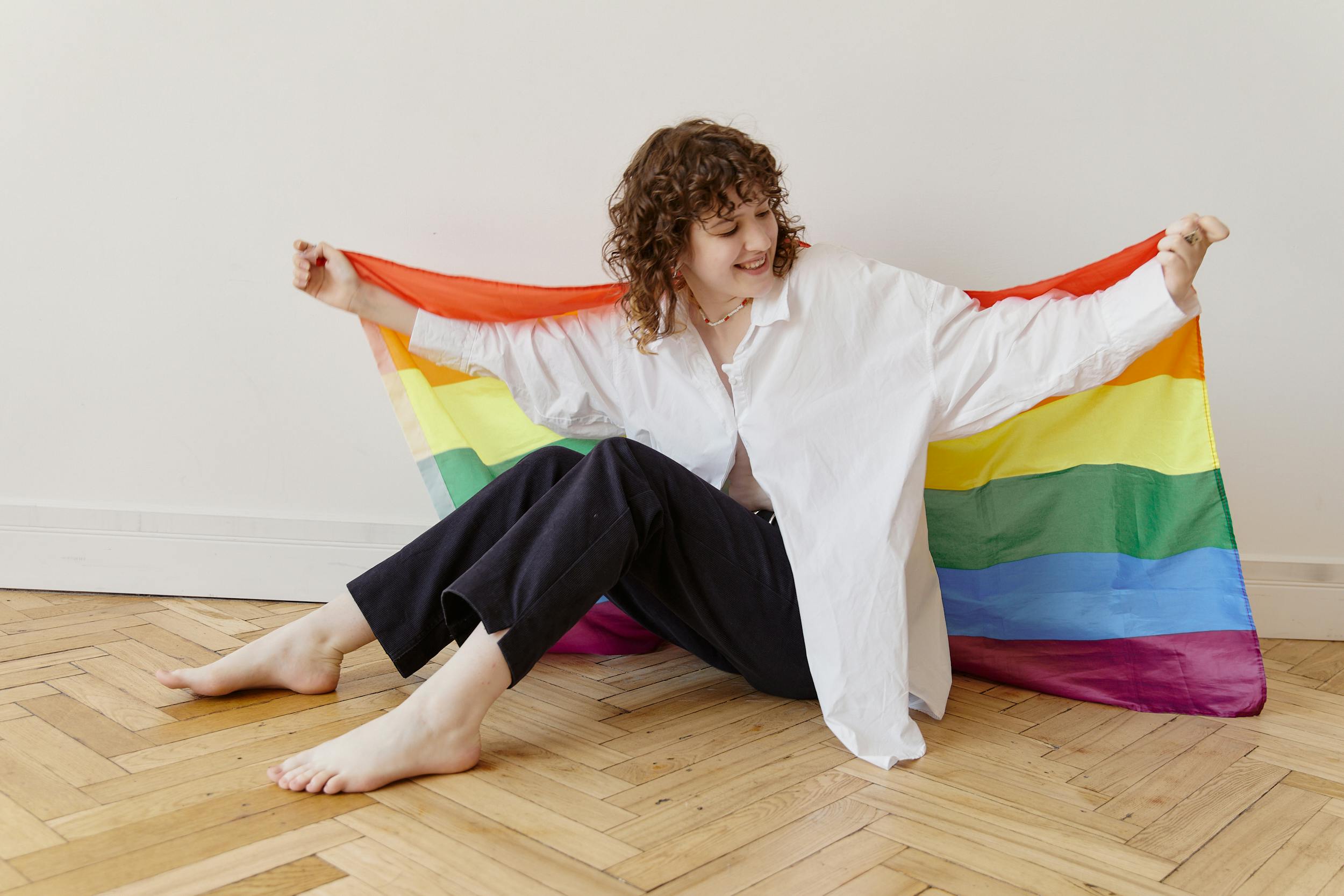

Do You Really Understand Lesbianism?
When the term "lesbian" is mentioned, you’ve probably heard casual nicknames like "lala", "Les" and "leisibian" (Chinese colloquial terms for lesbians), and you may have seen related characters in movies, TV shows and variety programs. But beyond the labels and stereotypes—what exactly is lesbianism? Why do attitudes toward it vary so drastically across different eras? Today, we’ll break it down in plain language, covering everything from its definition to its historical evolution in one go.
First, the Core Truth: Lesbianism Is Not a "Choice"—It’s a Natural Trait
Simply put, lesbianism (often shortened to "les") refers to the sexual orientation of biological females who are primarily emotionally, romantically or sexually attracted to other biological females. Here are three key misconceptions that many people fall for—let’s set the record straight:
It’s not "failing to meet the right guy": Sexual orientation has nothing to do with "picking a partner". Just as a heterosexual person won’t suddenly fall for someone of the same sex because they haven’t met a good opposite-sex partner, a lesbian’s attraction to women is instinctual—it’s never a second choice.
It’s not "acquired later in life": Current psychological and genetic research confirms that sexual orientation is shaped by a combination of factors such as innate genes and hormone levels. It has no direct causal link to "family environment" or "childhood experiences".
It doesn’t require rigid role labels: The online labels "T/P/H" (tomboyish/ feminine/ neutral - leaning) are voluntary classifications within the community—they are by no means a "must - have" for lesbians. Many people reject these labels entirely; they simply love women, plain and simple.
More importantly: Sexual orientation ≠ behavior ≠ identity. Some people may clarify their identity early in life, while others may not realize it until adulthood. Some may have had intimate relationships, while others haven’t. None of these factors change the core definition of being a lesbian—the key lies in the direction of one’s inner attraction.
Historical Evolution: 3,000 Years from "Hidden Existence" to "Open Acceptance"
Lesbianism is not a "modern invention". It has existed in various civilizations for thousands of years, but the terms used to describe it and the treatment of lesbians varied wildly across eras. We can roughly divide this history into three phases:
Phase 1: Ancient Times—"Unnamed, but Truly Existing"
There was no term for "lesbianism" in this era. People either regarded same - sex female relationships as "special friendships" or categorized them as "private preferences", yet traces of these relationships can be found everywhere in historical records.
In ancient China, the most typical examples were "mo jing" (grinding mirrors) and "jin lan qi" (golden orchid bonds). "Mo jing" was a term dating back to the Han Dynasty, referring to the intimate physical connection between women—their bodies were seen as mirroring each other, like two mirrors rubbing together. The "golden orchid bonds" of the Ming and Qing dynasties were even more fascinating: some women would hold formal ceremonies similar to weddings to form lifelong partnerships, live together, call each other "sworn sisters" or "bonded siblings", and even make agreements to be buried together after death. For instance, the Qing Dynasty text Notes on Eastern Guangdong recorded that in Guangdong, there were women who "addressed each other as sisters, never married, and lived together until old age".
The concept was also familiar in ancient Western civilizations. In ancient Greece, Spartan girls formed "mentor - like intimate relationships" with older women—bonds that included both emotional connection and sexual attraction, and were even seen as a way to "cultivate courage in young women". The ancient Greek poet Sappho wrote countless love poems dedicated to women, so much so that the term "Sapphic" later became one of the alternative names for lesbianism.
It’s important to note, however, that these ancient relationships were rarely recognized as an "independent sexual orientation". They were either idealized as the "ultimate form of friendship" or treated as a "pastime of the upper class". For ordinary women, such relationships had to remain hidden—they dared not be open about them.
Phase 2: Modern Times—From "Mental Illness" to "Community Awakening"
The 19th century marked a crucial turning point. As sexology emerged as an academic discipline, scholars began defining different sexual orientations—but their initial approach was completely off track.
In 1869, German scholar Karl Kertbeny first coined the term "homosexuality". Yet mainstream society at the time regarded it as a "mental disorder" or "gender inversion". For example, lesbians were thought to be "women who wanted to become men". Some doctors even resorted to electric shock therapy and hormone injections in a futile attempt to "correct" sexual orientation. This misguided belief persisted until the mid - 20th century; in the United States, for instance, homosexuality was not removed from the list of mental illnesses until 1973.
The greater the oppression, the stronger the resistance. In the early 20th century, secret lesbian communities began to emerge in Europe and America. One famous example was New York’s Stonewall Inn, a popular gathering spot for lesbians, gay men and transgender people. In 1955, American feminist Del Martin founded the Daughters of Bilitis—the first lesbian rights organization, named after an ancient Greek poem depicting lesbian affection. This marked the moment when lesbians stepped out of the shadows and began speaking up publicly.
In modern China, influenced by both Western culture and local traditions, lesbian relationships were mostly hidden under the guise of "teacher - student" or "classmate" bonds. For example, same - sex attraction was common in girls’ schools during the Republic of China era, and was euphemistically called "excessive friendship". While such relationships were not accepted by mainstream society, they were not persecuted as a "mental illness" like in the West—instead, women were simply pressured to "return to a normal marriage".
Phase 3: Contemporary Era—From "Fighting for Rights" to "Diversity and Inclusion"
After the 1960s, the global situation for lesbians underwent a transformative shift. The core goal evolved from "proving we’re not sick" to "fighting for equal rights".
The 1969 Stonewall Riots were a pivotal event. When New York police raided the Stonewall Inn, the marginalized community members who had long endured oppression staged their first collective resistance. This uprising directly fueled the global LGBTQ+ rights movement, and lesbians moved from the sidelines to the forefront of the fight. They not only opposed discrimination based on sexual orientation, but also pushed back against the male - dominated nature of early rights organizations that ignored women’s needs—fighting for critical rights such as inheritance rights and hospital visitation rights for same - sex partners.
In the 21st century, the biggest changes have been the legalization and diversification of lesbian relationships. In 2001, the Netherlands became the first country to legalize same - sex marriage. As of 2024, same - sex marriage is legal in over 30 countries and regions around the world. The Taiwan region of China also passed the Same - Sex Marriage Act in 2019, providing clearer legal protections for lesbian couples. At the same time, acceptance within the community has become increasingly inclusive—rigid labels like "T/P" are no longer the focus, and "being yourself" has become the core value. Whether you identify as tomboyish, feminine, or anything in between, you can find a space to be accepted in the community.
Looking Back: The Core Desire Remains Unchanged
Throughout this long history of change, the core desire of the lesbian community has never wavered. From the hidden companionship of ancient "mirror - grinding" and "golden orchid bonds", to the secret solidarity of the Daughters of Bilitis in modern times, to the public fight for rights today—at its heart, it’s all about wanting to be seen, understood, and accepted.
The rise of the internet has made cross - regional, cross - community connections more accessible than ever before. Platforms like LesPark—designed exclusively for lesbians—were created to meet this exact need.
Unlike mainstream social apps, LesPark addresses the two biggest pain points of lesbian dating from the ground up: identity anxiety and inefficient matching. There’s no awkwardness of having to "test someone’s orientation", and no need to waste time on people who aren’t a good fit. More and more women are letting go of their masks on LesPark, embracing their true selves, and finding people who get them—whether it’s a fellow fan who stays up late chatting about lesbian dramas, a buddy to visit women’s bookstores with, or a partner to face life’s challenges alongside.
Three thousand years of hiding and awakening have finally led to the simple, everyday joy of "easily meeting your people". If you’re looking for this kind of connection, LesPark is a warm place to start. Here, your interests will be seen, your sincerity will be reciprocated. Just like those ancient women who loved in secret could never have imagined—today, we can openly and unapologetically search for "the one who understands me".